For many local businesses, the first employee a customer meets is no longer the person at reception.
It is Google.
Not the website. Not the Facebook page. Not the Instagram profile. Google.
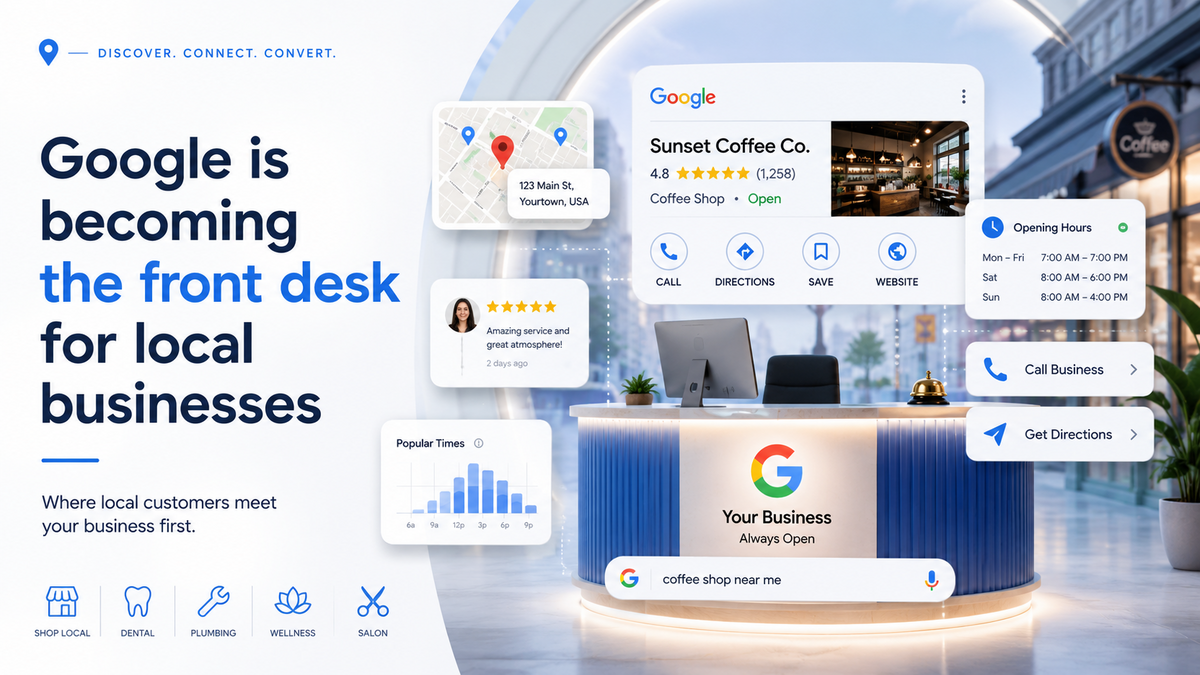
The customer searches. Google shows options. Google shows reviews. Google shows opening hours. Google shows photos. Google shows directions. Google may show ads, maps, local results, business profiles, call buttons, booking buttons, messages, verified badges and sometimes answers before the customer even visits a website.
In other words, Google is slowly becoming the front desk for more and more industries.
That is not a philosophical statement. It is a practical business reality.
If someone searches "dentist near me", "roof repair", "pet grooming", "car mechanic", "lawyer", "restaurant", "hotel", "eshop support", "laptop repair", "web agency", "accountant", "yoga studio" or "cleaning service", the first impression often happens inside Google. The customer may decide who feels serious, who looks alive, who has trust signals and who is worth contacting before opening a single website.
For Greek businesses, this creates both an opportunity and a problem.
The opportunity is obvious: you can be discovered at the exact moment someone is looking for what you sell.
The problem is less comfortable: if your Google presence is weak, outdated or inconsistent, your customer may judge you before you even know they existed.
Welcome to the new front desk.
The customer journey starts before your website
Many business owners still think the journey starts when someone lands on their website.
That used to be closer to the truth. A customer would hear your name, type your URL, open your homepage, browse your services and maybe contact you.
Today the journey often starts earlier.
The customer searches on Google. They see a map pack. They compare star ratings. They scan reviews. They check photos. They notice whether the business is open. They look at the address. They tap call. They open directions. They check if there are recent posts or updates. They compare you with two or three competitors without ever visiting your site.
By the time they reach your website, they may already have an opinion.
That opinion can help you or hurt you.
If the Google Business Profile is complete, reviews are recent, photos look real, categories are accurate and the website matches the same level of professionalism, the customer feels continuity. Everything says, "This business is active and serious."
If the profile has old photos, wrong hours, no clear services, weak reviews, inconsistent phone numbers and a website that feels abandoned, the customer feels doubt.
And doubt is expensive.
It does not always appear in analytics. It does not show up as a dramatic technical error. It appears as silence. Fewer calls. Fewer forms. Fewer bookings. More price-sensitive leads. More people who choose someone else because the first impression was cleaner.
The front desk failed before the salesperson had a chance.
Local Services Ads changed the shape of local discovery
Google's Local Services Ads are a good example of where local search is going.
They are not just normal text ads. They are built around local intent, service categories, verification, lead generation and direct contact. Google describes them as ads that help local businesses receive leads directly from potential customers, such as calls and messages. Google also emphasizes verified badges, local placement and paying for leads rather than only clicks.
That matters because it changes how customers behave.
When a customer searches for a service, they are not always looking for a nice brand story. Many times they want:
- someone nearby
- someone available
- someone trustworthy
- someone easy to contact
- someone with reviews
- someone who looks verified
- someone who reduces risk
This is why Google is pushing more local business categories into structured discovery surfaces. Home services, professional services, healthcare, learning, care, wellness, beauty, automotive and other categories are increasingly presented in a way that feels like a marketplace, not a simple search results page.
That does not mean every business should blindly run Local Services Ads. Not every market, category or budget will make sense.
But every business should understand the signal.
Google wants to reduce friction between local intent and local action.
Search becomes call. Search becomes message. Search becomes booking. Search becomes direction. Search becomes comparison.
If your business is not prepared for that environment, you are not only losing "SEO." You are losing front-desk moments.
Your website still matters, but its job has changed
Some people hear this and assume the website is becoming less important.
Wrong.
The website is still important. In many cases, it is more important.
But its job has changed.
Your website is no longer always the first touch. Sometimes it is the second or third touch. The customer may first see you on Google, then compare your reviews, then open your website to verify that you are real, serious and suitable.
That means your website must support the decision that started on Google.
It must answer the questions that Google cannot fully answer:
- What exactly do you offer?
- Who is this for?
- Why should I choose you?
- What makes you trustworthy?
- What does the process look like?
- What should I do next?
- Can I contact you quickly?
- Is this business active?
- Does this feel professional enough for my money?
For ecommerce, the website has an even heavier job. Google may bring the visitor, but the site must handle trust, product clarity, speed, checkout, shipping information, payment options, returns, support and post-purchase confidence.
For service businesses, the site must turn interest into inquiry. It must show the service clearly, make contact easy and remove doubts.
For local businesses, the site must match the reality of the business. If the Google profile looks modern but the website feels dead, trust drops. If the website looks professional but Google shows wrong hours or poor photos, trust drops again.
Digital trust is not one asset.
It is the consistency between assets.
The Greek business problem: "we have it somewhere"
In Greek businesses, a very common digital problem is not total absence. It is fragmentation.
The information exists somewhere.
The opening hours are somewhere. The correct phone is somewhere. The new services are somewhere. The latest photos are somewhere. The menu is somewhere. The booking link is somewhere. The VAT information is somewhere. The customer support process is somewhere.
The problem is that "somewhere" is not a strategy.
Customers do not have the patience to solve your internal puzzle.
We have seen this before: the owner believes the business is easy to understand because the owner lives inside it every day. But the customer sees only fragments.
One phone number on Facebook. Another phone number on the website. Old hours on Google. New prices on Instagram. No service details on the site. Reviews from years ago. Photos from the previous renovation. A contact form that sends nowhere useful.
This is not a small cosmetic issue. It is a conversion issue.
When information is inconsistent, the customer slows down. When the customer slows down, doubt enters. When doubt enters, the next competitor is one tap away.
The customer does not think, "This company has a data governance issue."
The customer thinks, "I am not sure."
And "I am not sure" is often enough to lose the lead.
Reviews are not decoration
Reviews are one of the strongest trust signals in local discovery.
Business owners know this, but many still treat reviews as passive decoration. Something nice to have. Something that happens if customers remember. Something to check once in a while.
That is not enough.
Reviews influence visibility, trust and conversion. They help customers understand not only whether people liked the business, but what kind of experience they had.
A good review profile does several things:
- proves the business is active
- shows recent customer experience
- answers doubts indirectly
- gives language customers trust more than marketing copy
- helps Google understand relevance
- creates confidence before contact
The quality of the replies also matters.
A business that replies calmly, clearly and humanly looks alive. A business that ignores everything looks careless. A business that argues publicly with customers looks dangerous.
This does not mean every reply must be long. In fact, many should be short. But the pattern matters.
If Google is your front desk, reviews are the people in the waiting room telling the next customer what to expect.
You cannot fully control them.
But you can manage the experience that creates them, ask at the right moments and respond like a business that pays attention.
AI makes the front desk faster, but not automatically better
AI is now part of the same story.
Customers are using AI tools to search, compare, summarize and ask for recommendations. Platforms are using AI to generate answers, detect scams, interpret intent and automate advertising. Businesses are using AI to write content, answer messages, generate ideas and analyze data.
This can be useful.
It can also create a lot of confident noise.
If your business information is outdated, unclear or scattered, AI systems may summarize the wrong thing faster. If your website is vague, AI cannot magically understand your positioning. If your Google profile is weak, AI does not invent trust. If your reviews are poor, AI may surface that weakness more efficiently.
AI does not remove the need for good digital foundations.
It makes weak foundations more visible.
This is the boring truth many businesses do not want to hear. Before asking "How do we use AI?", many should ask:
- Is our business information correct everywhere?
- Is our website clear?
- Are our services explained properly?
- Are our reviews recent?
- Do our pages answer real customer questions?
- Can someone contact us without friction?
- Do we know which channel brings serious leads?
- Do we have a process for updating information?
AI can help with all of this.
But it should not be used to decorate confusion.
What businesses should fix first
If Google is becoming the front desk, the first step is not to panic or buy every new tool.
The first step is to clean the basics.
Start with your Google Business Profile. Check business name, category, phone, address, hours, services, photos, website link, messaging options and review status. Make sure the profile reflects the business as it is today, not as it was three years ago.
Then check your website. Does the homepage explain what you do quickly? Are the service pages specific? Is the mobile experience comfortable? Are contact points obvious? Are forms working? Is tracking installed correctly? Are pages fast enough? Is there proof, not just claims?
Then check consistency. Does Google say the same thing as the website? Does Facebook match? Does Instagram match? Does LinkedIn match? Do ads send people to pages that make sense? Do phone numbers and emails match?
Then check conversion points. For a local service business, that may mean calls, forms, bookings, directions and WhatsApp. For ecommerce, it means product pages, cart, checkout, payment, shipping, returns and support.
Then check follow-up. What happens after someone calls, sends a message or fills a form? Is there a process, or does the lead disappear into "we will answer later"?
This is not glamorous work.
It is front desk work.
But front desk work sells.
The businesses that win will look easier to choose
A lot of digital marketing advice sounds complicated because the tools are complicated.
But from the customer's side, the decision is often simple.
Who looks clear? Who looks active? Who looks trustworthy? Who makes the next step easy? Who seems less risky?
That is why the front desk metaphor matters.
Your Google presence, website, reviews, ads and social profiles are not separate trophies. They are parts of one customer experience. If they do not work together, the customer feels it.
The future of local digital presence is not just "rank higher."
It is "be easier to choose."
That means a business must stop treating Google as a listing, the website as a brochure and reviews as decoration.
Google is becoming the front desk. Your website is becoming the proof room. Your reviews are becoming the trust layer. Your content is becoming the explanation. Your process is becoming the difference.
The businesses that understand this will not necessarily be the loudest.
They will be the easiest to trust.
And in local markets, that is often enough to win.
Practical checklist
Use this as a quick audit:
- Is your Google Business Profile accurate today?
- Are your primary services listed clearly?
- Are your opening hours correct, including holidays?
- Are your photos recent and real?
- Do your reviews show recent activity?
- Do you reply to reviews professionally?
- Is your website mobile-friendly?
- Can someone contact you in one or two taps?
- Do your website and Google profile say the same thing?
- Are your service pages specific enough?
- Are your forms tested?
- Do you know where leads go after submission?
- Are your ads connected to pages that match the promise?
- Can a customer understand why to choose you in under one minute?
If the answer is "no" to several of these, the problem is not only marketing.
It is customer experience.
And customer experience starts before the customer talks to you.
Final thought
Many businesses still ask, "Do we need a better website?"
Sometimes yes.
But the sharper question is:
"Does our digital presence help customers choose us?"
Because that is the real job now.
Not to exist online. Not to look busy. Not to chase every new trend.
To be found, understood, trusted and contacted.
Google may be the new front desk.
But the business still decides what kind of experience the customer finds when they walk in.